
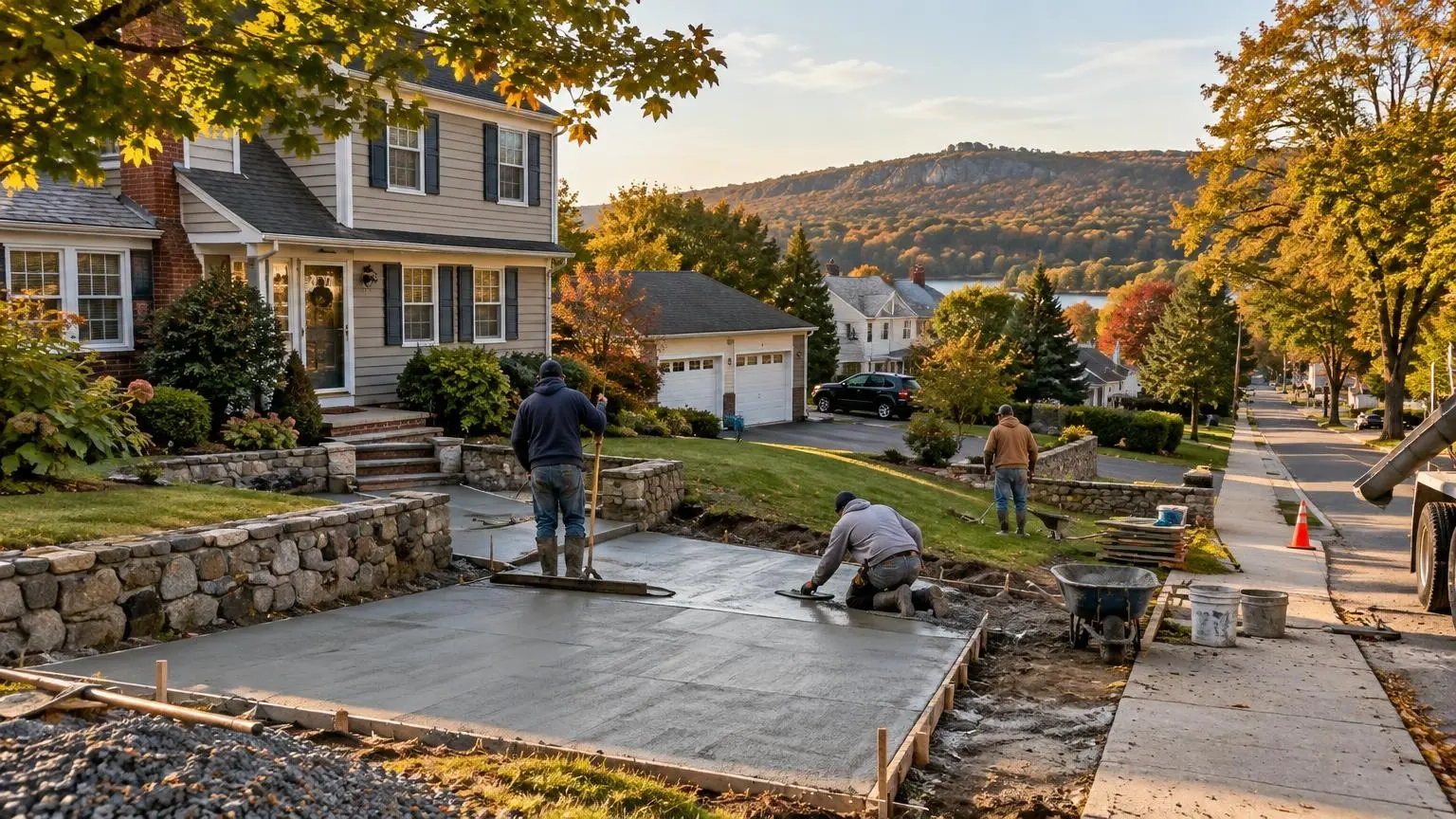
Thirteen neighborhoods in the shadow of Sleeping Giant
Concrete Contractors in Hamden, CT
Driveways, patios, walks, steps and slabs for a town that grew from village clusters into a suburb of more than 61,000 people.
- Free estimates after we see the site, priced line by line
- Entrained-air mixes, planned joints and a full cure on outdoor pours
- Town approval questions settled before your date is booked
Concrete Work Across Hamden, Neighborhood by Neighborhood
For concrete contractors, Hamden packs a wide spread of houses, lots and slab conditions inside one set of town lines. The 2020 census counted 61,169 residents across about 33 square miles. The southern end of town is built up so tightly that Wikipedia describes it as hard to tell apart from New Haven, while the north around Mount Carmel and Sleeping Giant still feels rural. A driveway in Spring Glen and a driveway off a wooded road in the north end face the same New England winters, but they rarely need the same plan.
A town built in waves
Hamden split off from New Haven in 1786 with about 1,400 people, and it grew as a set of village-like settlements. Several of them are still distinct: Augerville, Beecher Heights, Centerville, Dunbar Hill, Hamden Plains, Highwood, the Mix District, Mount Carmel, Pine Rock, Spring Glen, the State Street area, West Woods and Whitneyville.
The census history shows two big jumps. Between 1920 and 1930 the population went from 8,611 to 19,020, a gain of 120.9 percent. After World War II it climbed again, from 29,715 in 1950 to 41,056 in 1960. That means a large share of Hamden homes have walks, steps and driveways that have been through many decades of freeze and thaw, and some have been patched more than once.
When we look at an older slab here, we check for the usual signs of age:
- Heaved or sunken sections where roots or settled fill have moved the base
- Scaling and pitting on the surface, often from years of deicing salt
- Cracked or rocking steps at the front door, where the slab has pulled away from the foundation
- Low spots that hold water and turn to ice in January
South end: tight lots and old walks
In neighborhoods closer to the New Haven line, lots are smaller and the concrete is often squeezed between a house, a neighbor's fence and the street. Sidewalks and steps are the most common requests here. Removal has to be planned so debris comes out by the narrowest route, and forms often go up against existing walls. We measure the rise on front steps carefully, because older stairs were not always built with even risers, and a new set should be safe to walk at night.
North end: longer drives and more room
Around Mount Carmel, the Quinnipiac University campuses and the roads that climb toward Sleeping Giant State Park, lots open up. Driveways run longer and many homes have space for a detached garage, a shed or a backyard patio. On these jobs the base matters most. A long drive on sloped ground needs a properly graded and compacted gravel base and a pitch that sends water off the slab, not down the middle of it toward the garage door.
Water: Mill River, Lake Whitney and many small streams
The Mill River starts in the north of town, is dammed to form Lake Whitney and runs on to Long Island Sound. The Quinnipiac River, Lake Wintergreen and a number of small streams also cross Hamden. Homes near low ground or along these waterways can deal with wetter soils, and that changes how we build. We may deepen the gravel base, pay closer attention to pitch and suggest a drain where roof runoff dumps onto a patio. Concrete itself handles water well. It is a saturated base that freezes and lifts that cracks it.
Detached houses, multi-family homes and rentals
Point2Homes' summary of Census survey data shows 55.7 percent of Hamden housing is single-family detached and 62.4 percent is owner-occupied. The remainder is attached houses, multi-unit buildings and rentals. That mix changes how a job gets planned:
- A detached house usually has one decision-maker from the curb to the back fence, so a driveway, front walk and patio can be designed as one project.
- A two-family or multi-unit building often has shared walks, back stairs and parking pads, and every household needs a way in and out while new concrete cures.
- A rental property calls for durable, low-upkeep surfaces: a plain broom finish, sealed, with joints that keep cracks neat.
In every case the outdoor slab gets entrained air, a compacted stone base and joints laid out before the pour.
Main roads and the town right-of-way
Route 10 (Dixwell Avenue), Whitney Avenue, Route 40 and the Wilbur Cross Parkway are Hamden's main routes. For a house on one of those roads, the concrete truck is timed and placed to stay out of travel lanes as much as possible. Work on the public sidewalk or the apron at the curb can fall under town rules, so we confirm with the Town of Hamden what your job needs before a date is set.
Hamden Facts That Shape a Concrete Job
- Two growth spurts. Hamden grew 120.9 percent between 1920 and 1930, from 8,611 to 19,020 people, then rose from 29,715 in 1950 to 41,056 in 1960.
- City-like south, rural north. The southern part of town is urbanized and blends into New Haven, while the north around Mount Carmel and Sleeping Giant keeps a rural feel.
- Rivers and lakes. The Mill River is dammed to form Lake Whitney, and the Quinnipiac River, Lake Wintergreen and many small streams also run through town.
- Size of the town. The 2020 census counted 61,169 residents on about 33 square miles, at roughly 1,860 people per square mile.
Hamden Questions
My Spring Glen front steps are cracked and pulling away from the house. Can they be repaired?
Sometimes. If the stairs are solid but the surface is worn, a repair can work. If they have settled and tipped away from the foundation, the base underneath has failed, and a patch will not hold. In that case we remove them and build new steps on a compacted base with even risers.
Do you pour driveways on the hilly roads in north Hamden?
Yes. Sloped driveways need careful grading so water runs off the sides instead of down the slab, and a broom finish that gives tires and shoes grip in winter. We look at the slope on site before we put the plan in writing.
Do I need a permit to replace my driveway apron in Hamden?
It depends on the work. Anything that touches the town sidewalk or the curb may need town approval. We check with the Town of Hamden before we schedule the job and tell you what applies.
Free Estimates in Hamden, CT
Free estimates anywhere in Hamden, from Whitneyville to Mount Carmel.
Concrete Contractors Near Hamden
- Concrete Contractors in New Haven, CT
- Concrete Contractors in North Haven, CT
- Concrete Contractors in Wallingford, CT
- Concrete Contractors in Cheshire, CT
- Concrete Contractors in West Haven, CT
- Concrete Contractors in East Haven, CT
- Concrete Contractors in Branford, CT
- Concrete Contractors in Woodbridge, CT
- Concrete Contractors in Orange, CT
- Concrete Contractors in Milford, CT
- Concrete Contractors in Bethany, CT
- Concrete Contractors in North Branford, CT
- Concrete Contractors in Meriden, CT
- Concrete Contractors in Guilford, CT
- Concrete Contractors in Prospect, CT
- Concrete Contractors in Naugatuck, CT
- Concrete Contractors in Ansonia, CT
- Concrete Contractors in Seymour, CT
- Concrete Contractors in Derby, CT
- Concrete Contractors in Shelton, CT
- Concrete Contractors in Southington, CT
- Concrete Contractors in Madison, CT