
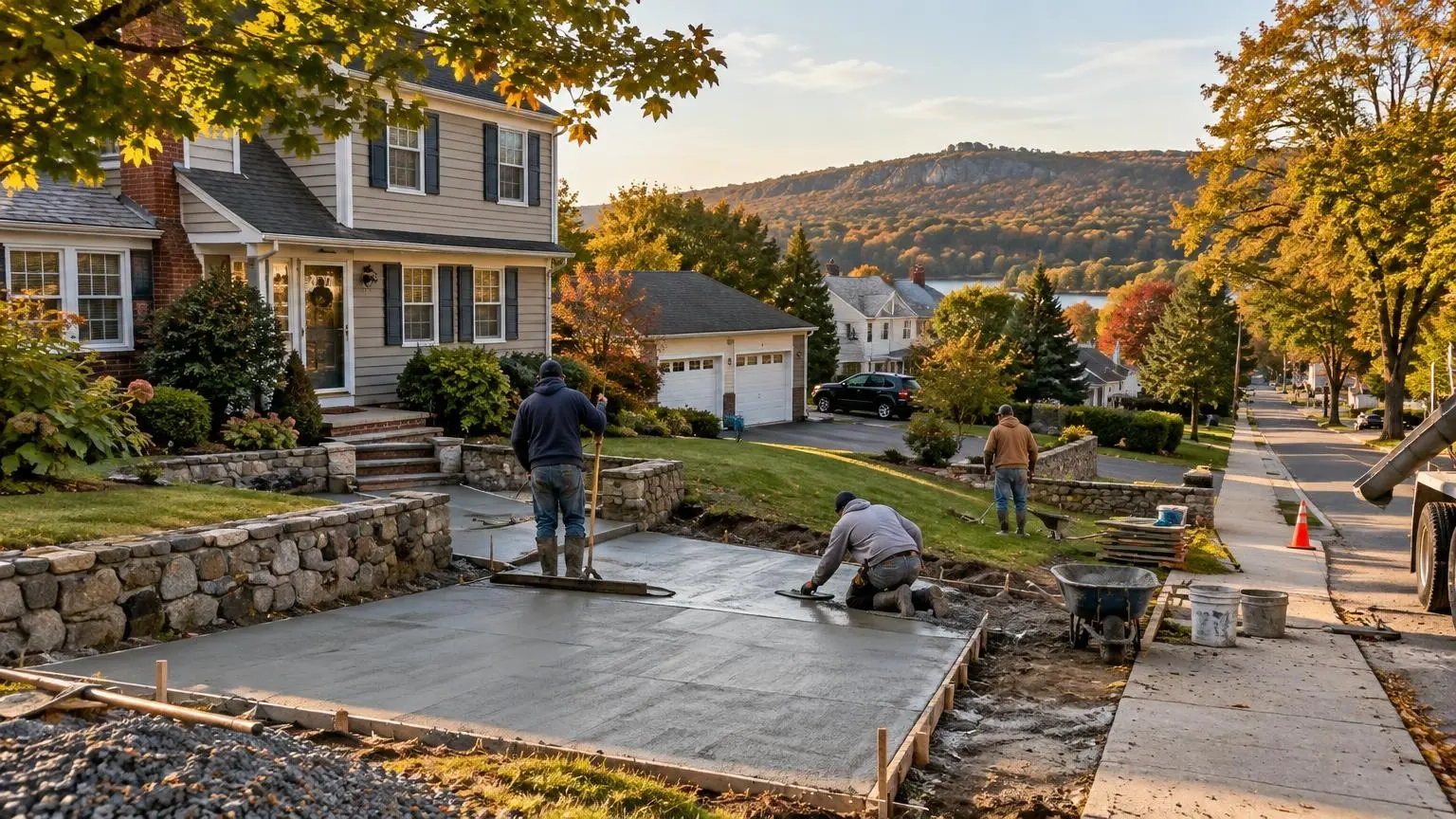
The Bedding Plant Capital of Connecticut
Concrete Contractors in Cheshire, CT
Patios, garden walks, driveways and slabs for a town where more than 54 inches of precipitation falls in a typical year.
- Free estimates after we see the site, priced line by line
- Entrained-air mixes, planned joints and a full cure on outdoor pours
- Town approval questions settled before your date is booked
Concrete That Works With Cheshire Yards
Cheshire sits just north of Hamden, and much of what concrete contractors do in this town happens in the backyard. Known as the Bedding Plant Capital of Connecticut, Cheshire is a place where people care about their gardens, and patios, garden walks and stamped surfaces are frequent requests. The town had 28,733 residents in 2020 across about 33 square miles, at an elevation of 230 feet.
Growth that came in one decade
Cheshire was settled in 1694 as part of Wallingford and became a town in 1780. For most of its history it stayed small. Then it more than doubled in ten years, from 6,295 people in 1950 to 13,383 in 1960, a 112.6 percent jump, and kept climbing to 25,684 by 1990. The 2020 census counted 10,401 housing units.
That timeline suggests many Cheshire houses date from the 1950s through the 1980s. Driveways and patios from those decades have now lived through many winters, and owners are updating them as they renovate.
Rain, cold and drainage
The climate table on Wikipedia gives Cheshire an average of 54.57 inches of precipitation a year, with every month falling between 3.61 inches in February and 5.52 inches in April. The average January low is 15 degrees and the July high is 83.
That is a lot of water, spread evenly through the year, and cold enough in winter to freeze it hard. For concrete, the risks are a saturated base that heaves in winter and surfaces that scale when water freezes in them. We plan for both:
- Pitch every slab so rain runs off quickly, usually away from the house and toward lawn or a drain
- Build on compacted gravel, which drains far better than native soil
- Use air-entrained concrete for every exterior pour
- Consider drains where downspouts or a hillside send water across a patio
Patios and garden walks
A patio in Cheshire often sits beside planting beds. We set forms so the edge of the slab meets your beds cleanly, and we keep the finished surface a little above the surrounding soil so mulch and water do not wash onto it. Garden walks can be plain or stamped concrete, and curved walks are no harder to form than straight ones.
For patios that will hold heavy planters or an outdoor kitchen, we thicken the slab where the load sits. Stamped patios get a sealer after curing, and we tell you how often to reseal so the color holds up.
Driveways on busy Route 10
Wikipedia calls Route 10 Cheshire's main north-south road and its busiest, and the Route 10 and Route 68/70 crossing is the busiest intersection in town. Interstate 691 skirts the north edge and Interstate 84 passes through the northwest. For homes on these roads, we schedule concrete deliveries so trucks spend as little time as possible blocking traffic. Where an apron or walk meets a town or state road, we confirm with the right office what approval is needed.
Wet ground, then a hard freeze
With an average January low of 15 degrees and steady rain or snow every month, Cheshire yards often go into winter wet. Saturated soil under a slab is what frost lifts, so on Cheshire jobs most of the attention goes to what sits under the concrete: soft or organic soil dug out, crushed stone compacted in layers, and a path for that base to drain. Downspouts that empty beside a patio or walk get extended or piped past it. On top, entrained air and a full cure let the slab cope with water that freezes inside it, and sealer slows how much soaks in. With July highs averaging 83 degrees, summer pours are kept damp so the surface doesn't dry before it gains strength.
The Farmington Canal Heritage Trail runs through town and Roaring Brook Falls sits in its southwest corner, and plenty of Cheshire life happens outdoors, including in the backyard.
Cheshire Facts for Concrete Planning
- Heavy, steady precipitation. Cheshire averages 54.57 inches of precipitation a year, ranging from 3.61 inches in February to 5.52 inches in April.
- Cold winters. The average January low in Cheshire is 15 degrees Fahrenheit, cold enough for hard freezes that test exterior concrete.
- A decade of doubling. The population grew 112.6 percent from 1950 to 1960, from 6,295 to 13,383 residents.
- Garden town. Cheshire is known as the Bedding Plant Capital of Connecticut, and the Farmington Canal Heritage Trail runs through town.
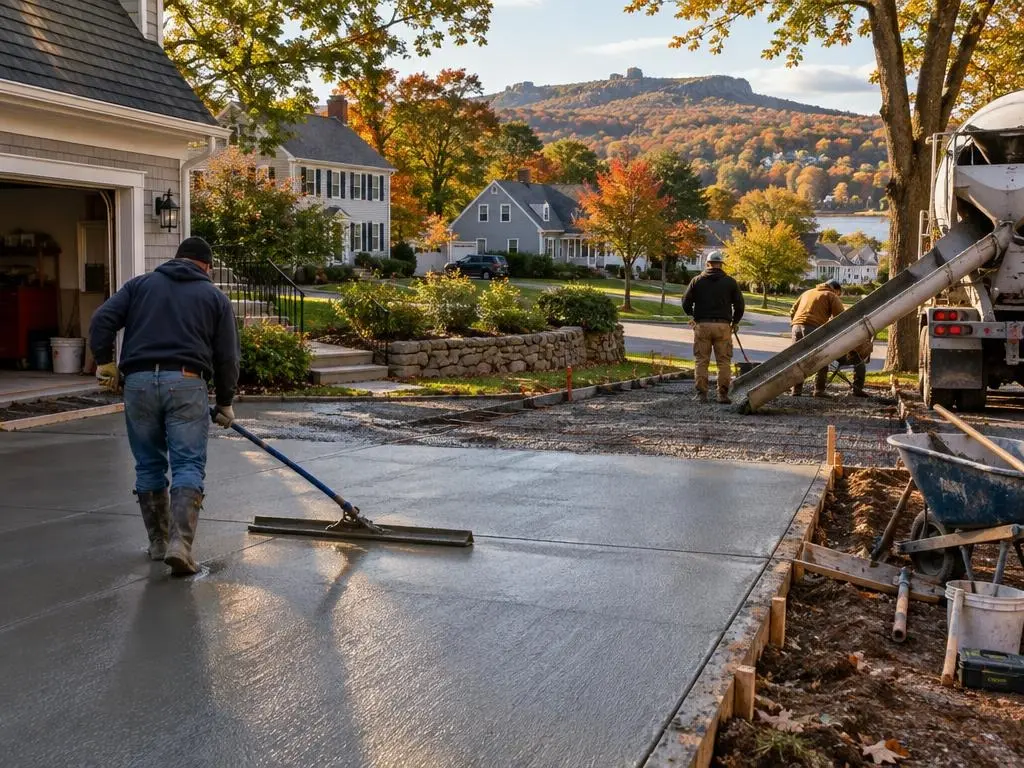
Cheshire Questions
Water pools on my Cheshire patio after every storm. Can that be fixed?
If the patio has settled into a low spot, the lasting fix is usually to remove it and pour a new slab with proper pitch on a compacted gravel base. In some cases a drain can help. We look at where the water comes from before suggesting either.
Can a patio be built right up to my garden beds?
Yes. We form the edge to follow your beds and set the slab slightly above the soil so mulch and runoff do not wash across it.
Is stamped concrete a good choice with Cheshire winters?
It can be, if it is air-entrained, properly cured and sealed. Resealing every few years helps the surface resist water and salt. We explain the upkeep before you choose it.
Free Estimates in Cheshire, CT
Free estimates for patios, walks and driveways across Cheshire.
Concrete Contractors Near Cheshire
- Concrete Contractors in Hamden, CT
- Concrete Contractors in New Haven, CT
- Concrete Contractors in North Haven, CT
- Concrete Contractors in Wallingford, CT
- Concrete Contractors in West Haven, CT
- Concrete Contractors in East Haven, CT
- Concrete Contractors in Branford, CT
- Concrete Contractors in Woodbridge, CT
- Concrete Contractors in Orange, CT
- Concrete Contractors in Milford, CT
- Concrete Contractors in Bethany, CT
- Concrete Contractors in North Branford, CT
- Concrete Contractors in Meriden, CT
- Concrete Contractors in Guilford, CT
- Concrete Contractors in Prospect, CT
- Concrete Contractors in Naugatuck, CT
- Concrete Contractors in Ansonia, CT
- Concrete Contractors in Seymour, CT
- Concrete Contractors in Derby, CT
- Concrete Contractors in Shelton, CT
- Concrete Contractors in Southington, CT
- Concrete Contractors in Madison, CT